
2022 STAKEHOLDERS UPDATE
KNOWLEDGE POINT NETWORK ANNUAL REPORT
We have a surprise!
by KPN Founder Ed Ponikvar on December 22, 2022
If we were to list all the 2022 successes, most would characterize the accomplishments as impossible concepts made into reality. For more info, go to KPNUSA.com.
Knowledge Point Network affords PTSD-suffering veterans and families a mission-purpose lifestyle. Unparalleled in its depth of service, we transport the individuals into the forest setting at their pace. In this activity, their PTSD is usually relieved and they gain a better view of life. Individuals who experience KPN’s valuable program repeatedly indicate they have found portals of hope never known to them prior to the KPN experience. They desired a personalized mental health approach on their terms. And KPN gave it to them and continues to do so. These PTSD sufferers are on the hunt for the next rung of a ladder out of their abyss of sorrow, malaise, self-pity, and anger. In a very short time, they find certainty and hope in the KPN’s depth of knowledge and network of subject matter experts.
This past year, we had:
100% increase in Youth served
100% increase in grant awards
100% Donations sustained YOY
100% increase in contracted grant writing
145% increase in Donations
150% Volunteer hrs up from $42,000 to $105,000
A quote captured during Tri-County Veteran’s Task Force annual meeting,
“The most successful program for 2022 was KPN’s workshops.”
2022 TOP ADAPTATIONS
Objective: Reduce self-harming behavior in youth through treatment that starts with the parent.
A puzzle piece for Zach Griffin, former Air Force Combat Veteran
Former business executive, now KPN volunteer, Tami Dunlap secured a significant cash donation. How did she do this? She leveraged her former employer’s philanthropy division at John Paul Mitchell Systems. We applied this unexpected gift squarely to the problem our mission seeks to solve. Ongoing pain points that were expressed by veterans guided our objectives. We decided to envelop multiple families with a 3D family art experience. A cadre of subject matter experts, plus a videographer, were contracted. Our initial aim was to report the impact of concentrated donor dollars. We received more than we bargained for. A critical gap in addressing generational self-harm behavior was brought into view. Going where angels fear to tread, KPN blended natural environmental activity, art, clinical support, and recreation on a path and then observed carefully. When we listened to the family participants, we learned a lot and shifted our priority of care for not only the PTSD sufferer but the whole family. KPN is about reducing self-harm to the child by making the parents as durable as possible. Offspring of military veterans are three times more likely to self-harm when a parent takes his/her own life. Our goal is to change this sad reality quoted here: “A PTSD-suffer cannot even feel the love of your own family.” Zach Griffin
Doubled our trail treatment with more to come
for Ray Milliard Fall 2022
KPN doubles down in Pennsylvania! Veterans will be served with a range of KPN curricula on a 870-acre PRIVATE venue. There are 40 miles of safe trails at Majestic Trails/Campground. Facilitating the 4th “Dozer Dogz program, we are engaged in building on-site clinical support.
KPNUSA Highlighted in the Media
Perseverance pays: Click to open or Google search “Ed Ponikvar Perseverance pays”
2023 Goals
- Source a clinician to be available at events in the field
- Secure funding by hiring individuals experienced in growing donations
- Distribution of “Get the word out” campaign through video and social media.
- Close the gap to achieve Operation 365
- Don’t Fix what’s not broken. Our donations doubled because we do what we say we are going to do at a level of service unparalleled.
Please make KPN your 2023 charity of choice: https://kpnusa.com/ways-to-give/#donate
- Decades of repeatedly overcoming all manner of barriers and bureaucracy
- KPN stands at the ready. Immediate fast-paced local response when it’s needed most
- 501c3 Tax-deductible charity with a twist. We earn donations by supplying broad-based solutions
- The KPN team is available 24/7 to clarify avenues of how to get and give. 936-446-7966
PLEASE COMMIT TO HELPING KPN IN 2023 WITH A RECURRING MONTHLY OR ANNUAL GIFT! WE MAKE EVERY DOLLAR STRETCH TOWARDS EMPOWERING VETERANS AND THEIR FAMILIES. PLEASE VISIT KPNUSA.COM TO CONTRIBUTE TODAY! https://kpnusa.com/non-cash-giving/#non-cash-giving
Perseverance Pays
Perseverance pays off in McKean County
By Marilyn McCann marilynm@tiogapublishing.com
SMETHPORT – Ed Ponikvar, a McKean county native now living in Texas and chief education Officer of Knowledge Point Network, a 501©3 charity and Brenda Fitch, owner of Majestic Kamp and Lost Trails on Route 46, are finally able to realize their common vision after receiving a $203,300 grant: to provide a respite for active duty military and their families whilecamping and trail riding at Majestic Trails.
Fitch has always hosted veterans and active-duty military. On Veteran’s Day weekend for the last two decades, it has been a free, four-day event for veteran and their immediate families. Now she plans on having Majestic Trails available to them 365 days a year. The request for grant money was declined for nearly three years. Majestic Trails persevered, and with the assistance of Ponikvar, they celebrated the success with state and local officials, local veterans and Legion members on Sept. 23. Majestic Trails was established in 2001 and now has more than 40 miles of mountainous technical trails for all kinds of vehicles. Spanning in excess of 1,000 acres Majestic Trails is enjoyed by thousands of people each year. Employing six full-time and four full-time individuals during the summer months, Majestic Trails grounds, including 75 annual campsites and a log home to rent, are kept pristine and safe. According to Ponikvar, the first order of business is to purchase a new bulldozer.
Fitch was eager to show attendees how Majestic Trails will benefit from the grant, grinning widely as she spoke. “I can’t wait to get started,” she said. Her enthusiasm was infectious, as attendees were directed to several side-by-sides that would take them on trails through lush, mountainous terrain. A few dirt bikes were there, including state Senator Cris Dush, R-Brookville, on an electric dirt bike. Upon reaching the overlook, many were heard commenting about the beauty of the ride and the vista that stretched for miles. Members from the Crosby American Legion #976, Smethport Legion #138 and various VFW posts presented the nation’s colors.
“I am glad to be here today to honor our veterans and troops,” said state Rep. Martin Causer. “We are truly in God’s country.” Dush, a retired Air Force master sergeant, acknowledged all who are currently serving in the military, including his son, and all those who have served. He then said, “This will be a place of rest and refuge for our veterans.” McKean County Commissioner Carol Duffy agreed. “I can’t say enough how much I appreciate those that have served, because without them we wouldn’t have the life that we have here, the freedoms. This is our country, our county. Let’s work together as a community. God bless America.” Ponikvar said that motorized, hiking, fishing, camping, and hunting plus retreat-themed events are proposed for expansion at Majestic Trails. He also plans to obtain a grant that will fund counseling services for veterans. Fitch and Ponikvar are optimistic about that task, realizing they have the backing from McKean county officials, state legislators and local support. “When we come together, we can be pretty efficient,” said Ponikvar.
Read the original at the Potter Leader-Enterprise
Also covered that day: Area officials gathered for celebration at Majestic Trails (The Bradford Era)
Area officials gathered for celebration at Majestic Trails
Area officials gathered for celebration at Majestic Trails
Print edition Saturday, Sept. 24, 2022 · Online Sept. 25, 2022
SMETHPORT — Officials from across the McKean County area as well as the state gathered together on Friday at Majestic Kamp & Lost Trails, Inc. to see for themselves where recent grant money will be spent, and to hear details about future plans.
Majestic Trails received just over $203,000 from the Department of Conservation and Natural Resources, part of the $1 million in overall grant funding for all-terrain vehicle and snowmobile facilities and trails in Pennsylvania.
Brenda Fitch, owner, was just as overjoyed at the celebration as she was for the announcement of funding, “there is still a lot to do, but this is the start of getting where we want to go. I can’t wait to get started,” she said as she was shivering in the morning sun and chatting with some of the others waiting for the event to begin. She smiled through the entire celebration.
Her business counterpart, Knowledge Point Network Director Ed Ponikvar, gathered the group.
Ponikvar, originally from McKean County, explained how all of what has been accomplished came to be.
“Brenda reached out to me, she knew that I could help with grants and she wanted to do more for veterans, and here we are,” he said after greeting everyone. “This first phase goes to getting the new bulldozer.”
With nearly 1,000 acres, Ponikvar explained, the trail options are extraordinary. Right now, there are a lot of well maintained and well routed trails for all kinds of vehicles. But the true outlook for the park is to welcome all abilities, especially for veterans.
Fitch has always hosted veterans and active duty military. On Veterans’ Day weekend, it is a four-day affair. She would like to see this eventually be a 365-day playground for those who need and want to come for respite.
Fitch and Ponikvar lead the group on a trail ride to the overlook. Most rode with a guide in a side-by-side, but Senator Cris Dush, R-Brookville, followed in the back on an electric dirt bike.
At the overlook, which many in the group did not know existed, the honor guard and rifle squad with members from the American Legion and the VFW in Smethport and Crosby, presented the colors.
“We are truly in God’s country,” said Rep. Martin Causer, R-Turtlepoint, “it’s a beautiful place that is going to serve veterans well. I was certainly glad to work with the fellow elected officials and others in support of the grant to expand opportunities here. The only thing I think about when I look across at this project is all the people it will benefit, all the veterans it will benefit.”
Retired Air Force Master Sergeant, Dush acknowledged his son who is serving and all those who have served, “it’s by God’s grace” there are people and organizations like this one to support them.
McKean County Commissioner Carol Duffy added, “We’re doing things better now, supporting them better. I can’t say enough how much I appreciate those that have served, because without them we wouldn’t have the life that we have here, the freedoms — this is our country, our county. Let’s work together as a community. God bless America.”
The group met up again for lunch at the Log Home, just down State Route 46 from the trail head. The Log Home is a five bedroom and three bathroom retreat that can be rented at a reasonable rate for stays of two days or more. There is plenty of room to stretch out and relax after a day of riding, and the fire pit looked inviting too.
Ponikvar discussed a few hopes and dreams Fitch has for the future of Majestic Trails.
“The trails bring the veterans in. Get them out there, deeper into the forest, closer to the heavenly Father, and the deeper into the healing,” he said. And, with the addition of some of the equipment and the adventure wheelchair, veterans of any mobility will be able to go out on a mission, “this is what some of them are missing, the mission and purpose — not just the fun and camaraderie.”
Site plans have been rendered and big things are possible. More information is expected in the coming year as details unfold. Majestic Kamp & Lost Trails worked hard to receive this first grant. It took nearly two years. Several longtime users of the trail, veterans, and even U.S. Rep. Glenn Thompson, R-Pa., wrote letters of support.
It will take more grant money down the road to get phase two started, but Fitch and Ponikvar are encouraged by the support from the area, McKean County officials, and state leaders who are all supportive of the military and veterans.
Source: The Bradford Era
Download the article (PDF) | Read the original at The Bradford Era
Also covered that day: Perseverance pays off in McKean (Potter Leader-Enterprise)
Fighting for the forest: Sam Houston National Forest in need of funding
Fighting for the forest: Sam Houston National Forest in need of funding
By Eva Vigh, Community Impact, February 19, 2020
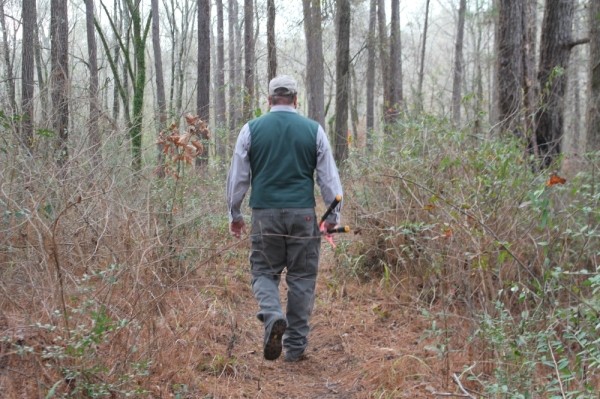
Ed Ponikvar, the vice president of Sam Houston Trails Coalition, walks along the West Side Multi Use Trails. The coalition needs more funds for Hurricane Harvey-related damages as well as trail maintenance. (Eva Vigh/Community Impact Newspaper)
The Sam Houston National Forest—which spans about 163,000 acres and 280 miles of trails across several counties, including Montgomery—is one of four national forests in Texas. It also draws visitors to the Conroe area, said Shannon Overby, director of the Conroe Convention and Visitors Bureau.
“The great outdoors is one of our major marketing pillars,” Overby said. “Probably one of the biggest reasons visitors come to the Conroe area is because of the outdoor activities offered here.”
But maintaining the forest is a daily fight against erosion, a lack of funding and years of improper design—largely fought by volunteers, officials said.
On Jan. 11, the East Side Trailhead—the last remaining portion of trails to be repaired following Hurricane Harvey damage in August 2017—was reopened. Harvey followed the Tax Day floods in April 2016, and it caused nearly $5 million in damages, said Ed Ponikvar, vice president of the Sam Houston Trails Coalition, a nonprofit dedicated to maintaining the forest’s trails. Both storms devastated the trails.
“These trails were all obliterated,” he said. “[The storms] made holes in the ground that were armpit deep. It just wiped out stuff, ripped bridges out.”
Proper trail construction could lessen storm damage, said Eddie Taylor, the U.S. Forest Service supervisor for the National Forests and Grasslands, a state agency. None of Sam Houston’s trails meets Forest Service standards, which include criteria on trail conditions, design and drainage.
In fact, only 16% of trails statewide met standards in fiscal year 2019, a decrease from 37% in
FY 2015, according to the Forest Service. Nationwide, the Forest Service—which helps manage more than 158,000 miles of trails across the U.S.—has a maintenance backlog of about 121,660 miles of trails.
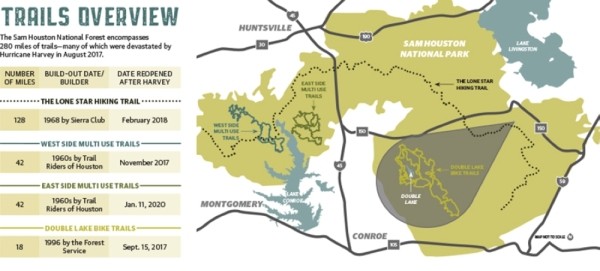
Infographic: Sam Houston National Forest trails overview. Community Impact Newspaper
The Sam Houston coalition is now turning to the community to help fundraise for critical projects such as repairing damaged bridges, officials said.
“It’s fallen on volunteers to provide improvements,” volunteer Jane Prentis said. “A lot of erosion control has been done, but more is needed.”
Erosion control
Erosion control
Most of Sam Houston’s trails were built in the mid-1900s without proper design guidelines and on sand that is highly erodible, forest officials said.
“Many of the trails … were not sustainably built nor well laid out,” said Trey Cooksey, a recreational trails program manager for the Texas Parks & Wildlife Department, a state agency.
When it rains on poorly designed trails, water flows directly down the path, eroding the soil, officials said. Proper design includes dips to divert water or rerouting to a zig-zag pattern.
Most of Sam Houston’s trails, such as the Lone Star Hiking Trail, are also on highly erodible sandy soil, coalition volunteer Allen Pape said.
“It’s one of the most difficult soil structures in the U.S. to build sustainable trails,” he said, adding that most trailheads have not seen improvements in 20-plus years.
Taylor said the Forest Service has worked to implement better trail construction as an agency.
“We have learned to value trail location,” he said. “New trails … are being built using the best trail construction practices.”
Funding challenges
Funding challenges
The Sam Houston National Forest relies on various revenue sources for funding, but it also gives back to the local economy, Ponikvar said.
Revenue sources include the state fuel tax, forest entry fees, and grants and donations—which total more than $5 million annually, Ponikvar said. The forest is also a designated wildlife management area, so fees collected from hunters pay for programs such as wild turkey restoration.
The forest offers camping, hunting, fishing and other recreational opportunities, as well as timber. When timber is removed, a portion of the funds return to the county for schools and roads.
The coalition has two Texas Recreational Trails Program grants from 2013 and 2014, which are administered by the TPWD, but the coalition needs community help to cover 20% of the cost, Pape said.
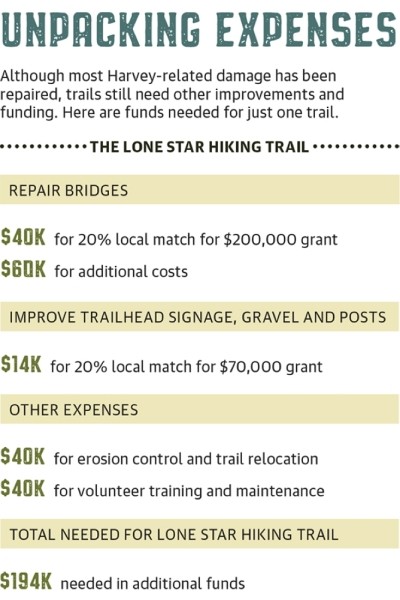
Infographic: unpacking the expenses for trail repairs. Community Impact Newspaper
Ponkivar said he has spent $40,000 over the years from his own pocket to pay for trail needs.
“We are being starved of … funds,” he said.
Nationwide issues
Nationwide issues
The Forest Service—which has worked on several projects at Sam Houston, including opening the East Side Trails—has undergone recent budget cuts. From FY 2017 to FY 2020, the Forest Service annual budget decreased from $6.07 billion to $5.69 billion.
“The [Forest Service once] had lots of money … and they have been cut, cut, cut,” Prentis said.
The National Forest System Trails Stewardship Act—which required the Forest Service to increase the use of volunteers and partners for trail maintenance without designating additional funds—was passed in 2016 in response to the nationwide maintenance backlog of trails. However, the percentage of national parks trails meeting Forest Service standards between FY 2016 to FY 2019 was only about 23%, according to the Forest Service.
This could be partially due to large rain events, which skew the numbers, Taylor said. But coalition members said it is a challenge to meet the criteria due to limited funds.
“In order to meet the standards, it would bankrupt you,” Ponikvar said.
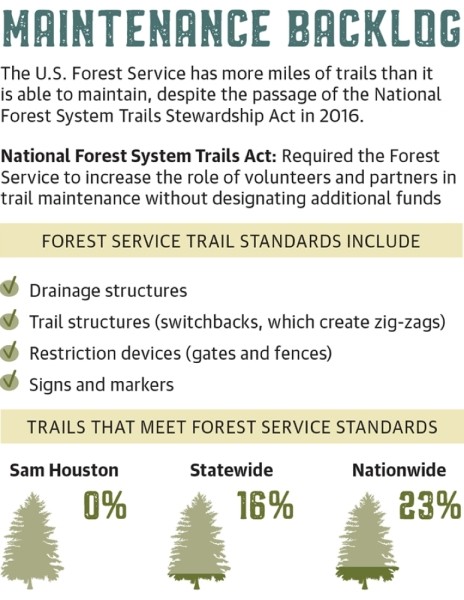
Infographic: the maintenance backlog and share of trails meeting Forest Service standards. Community Impact Newspaper
Despite the challenges, the Sam Houston National Forest remains a destination for Conroe and Montgomery-area residents such as Melanie Michaelchuk, who said she is preparing for her first overnight hike.
“I’m happy to have a place so close to home to explore,” she said.
To donate, visit https://www.samhoustontrails.org/
Ed Ponikvar: Maintaining trails in Sam Houston forest is all in a day’s work for this trailblazer
Ed Ponikvar: Maintaining trails in Sam Houston forest is all in a day’s work for this trailblazer
By Kyrie O’Connor, Houston Chronicle (Houston Gives), November 22, 2017
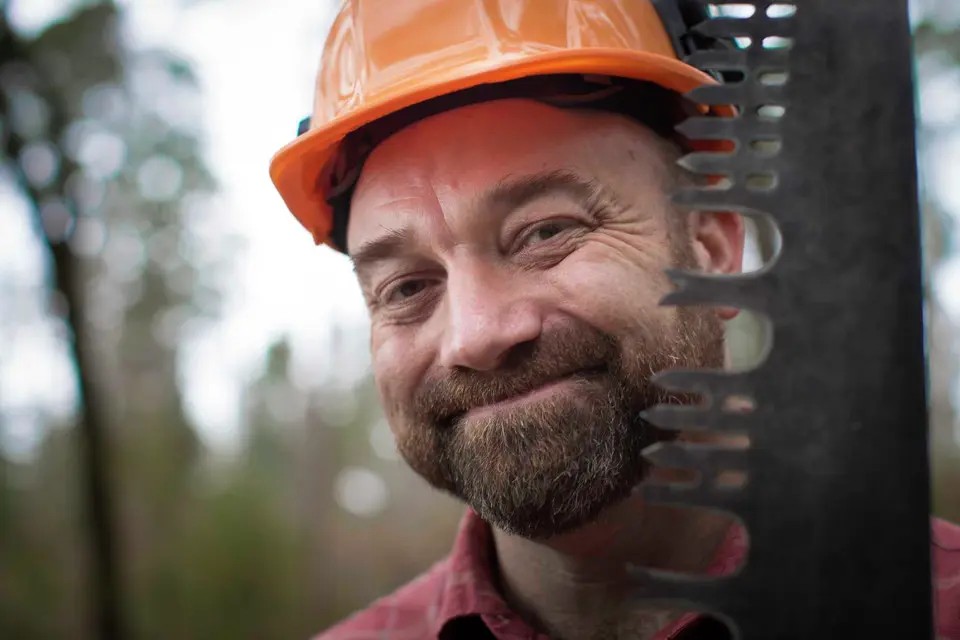
Sam Houston Trails Coalition president Ed Ponikvar coordinates volunteers to keep the Sam Houston National Forest a sanctuary for the native species and a safe beautiful space for the members of the public who enjoy nature. Monday, Feb. 6, 2017, in Houston. (Marie D. De Jesus / Houston Chronicle)

The Sam Houston Trails Coalition, a nonprofit organization, maintains the 275 miles of trails in the 163,037-acre Sam Houston National Forest. Photo: Godofredo A. Vasquez / Houston Chronicle
Ed Ponikvar is hefting his crosscut saw, a hulking, 80-year-old metal thing as tall as he is, with snaggle teeth like a sea monster’s. Its name is Rachel.
If you’re going to be out in the woods with someone, pick the guy who named his saw.
Ponikvar is the vice president of the all-volunteer Sam Houston Trails Coalition, a nonprofit that works with governmental entities on the Sisyphean task of maintaining the 275 miles of trails in the 163,037-acre forest 50 miles north of Houston.
Ponikvar works as a safety representative for a company that contracts with public schools for suicide prevention. He has been a volunteer with the trails coalition, which was founded in 2010, since 2011. The organization brings together the forest’s biggest “user groups” – hikers, equestrians, motorized-vehicle users, cyclists and paddlers – to work on maintaining the area, which includes the 128-mile Lone Star hiking trail, the longest in Texas. He reckons the forest saw 14,000 hours of volunteer time in the most recent fiscal year.
It’s one of only two such coalitions in the U.S., the other is dedicated to working on the Pacific Crest Trail in California.
Ponikvar works on projects with the U.S. Forest Service, but the labor is endless. “What we don’t do is we don’t wait,” Ponikvar said.
He is passionate in his admiration for the volunteers. “We have grandsons of volunteers out here, multiple generations,” he said, who are willing to do the unglamorous work of cutting brush, moving fallen trees, picking up garbage or broken glass and painting and keeping up signs. (Signs and even restrooms often show bullet holes.)
Rain, fire, drought and erosion can close trails, and the volunteers labor to open them up. Some areas won’t allow vehicles or chainsaws (hence Rachel). Sometimes volunteers have to schlep a 60-pound paver by hand.
But Ponikvar, whose career has been in educational services, himself has made a big difference in the volunteer effort. District Ranger Warren Oja remembers that after the May 2016 rainfall, which brought 30 inches of rain to the forest, he needed an assessment of damage to the 85-mile multiuse trail. The first effort failed, so Oja turned to Ponikvar.
He deployed volunteers all along the trail. Within a day, Oja said, Ponikvar had a computer map of the trail, with red and green triangles marking damage/no damage and photos of the destruction. “We couldn’t come close to that,” Oja said.
Ponikvar grew up in the woods, in rural Pennsylvania in the Appalachians, an hour and a half from the nearest four-lane road.
“I came out of the woods, and I’m still in the woods,” he said. “I’ve always been that kid.”
He and his wife moved to Montgomery in 2005 to be close to the Sam Houston National Forest.
To spend time with Ponikvar is to realize how much work it takes to make nature accessible to humans. He has certain mantras he uses often. “Get the sand in the forest and the water off the trail” is one.
“I do/we do/you do” is another, meaning: He will set the example, get others involved and then step back.
The coalition works on a shoestring, dependent on donations and grants. Ponikvar has flown out to California on his own dime to learn how to run a coalition. (By the same token, representatives from other states have come to Texas to observe SHTC’s practices.)
“We have a lot more grants and a lot more membership,” said 30-year volunteer Girard Lall. In prior years, the coalition meetings had attracted about 30 attendees. The last meeting, Lall said, drew 130. Ponikvar’s strengths, he said, are “inspiring and organizing. If he sees you out on the trail, he’ll approach you.”
Oja praises Ponikvar for putting in place a cellphone check in/check out tally of volunteer hours. Because many grants require either money or sweat equity, the accounting on volunteer hours has provided the equivalent of thousands of dollars.
Jane Prentis, a 35-year volunteer who is in the hiker user group, was a coalition skeptic. “I didn’t buy into the concept of a coalition,” she said. “I didn’t see how we would work together.”
But gradually she came to see that the former competing group had literal common ground. “Ed is a hands-on, get-in-the-mud kind of guy,” she said. “You could see him work through the resistance.”
Now, she said, they’re united. “Our goal is to preserve the forest for recreational activities for the future,” she said.
Spending time with Ponikvar also means realizing that maintaining “nature” involves a certain amount of manipulation. To encourage the growth of long-leaf pine trees, for example, means encouraging the yaupon and beautyberry bushes the long-leaf likes for company.
But the most important example is of the red-cockaded woodpecker, an endangered species that lives in holes in pine trees. Controlled burning of the underbrush helps the little bird survive. So, oddly, do trails. Ponikvar points to a map of the existing known trees where the woodpeckers live. Ten years ago, the forest had 144 family groups. Now it’s 285, and the goal is 500. It’s the largest population of the woodpecker west of the Mississippi. Almost all the inhabited trees are right along the trails.
“It’s one of the measurements I’m most proud of,” Ponikvar said.
Then there’s the future. “In five years, I’d like this to be an educational experience as well as a recreational one,” he said, “so that you leave the forest having learned something.”
He also wants to tell the story. “I’d like to be out telling the stories of this community, as sustainable and self-sufficient.”